
Growing Veggies in Mini-Garden Beds: When a Large Backyard Plot isn’t Feasible
Robert Ayson

If your grandparents had an edible garden, they might well have grown the veggies at the back of the house in a single well-tended plot. Still to this day, there are examples of remarkably productive edible gardens grown in precisely this fashion. But in the smaller sections which feature in today’s urban and suburban areas, large backyard plots are often a thing of the past.
When outside space is at a premium, what are your options if you still want to grow some vegetables for your kitchen and table? One answer, which reflects my experience over the past seven years in my current gardening situation, is to distribute vegetable growing across several micro-plots scattered across the section.
We live on a fairly generous parcel of land for a suburban space – over 800 square metres in total (about 1/5 of an acre). But given the area taken up by the house, two small sheds, and the paving (including a large driveway), about half of that area remains for potential garden, and that includes lawns as well as beds. Even so you might think that in about 400 square metres one ought to be able to find room for a single reasonably significant veggie plot – say a 5m by 3m space (15 square metres or about 150 square feet). But that has proven to be a bit of challenge.
To establish a garden bed of that size in the backyard (which has some good sun), I’d need to tear out quite a few paving stones and get rid of a boxed area I’ve found useful for propagating small seedlings and cuttings. Here is a photo of that area as it currently stands:
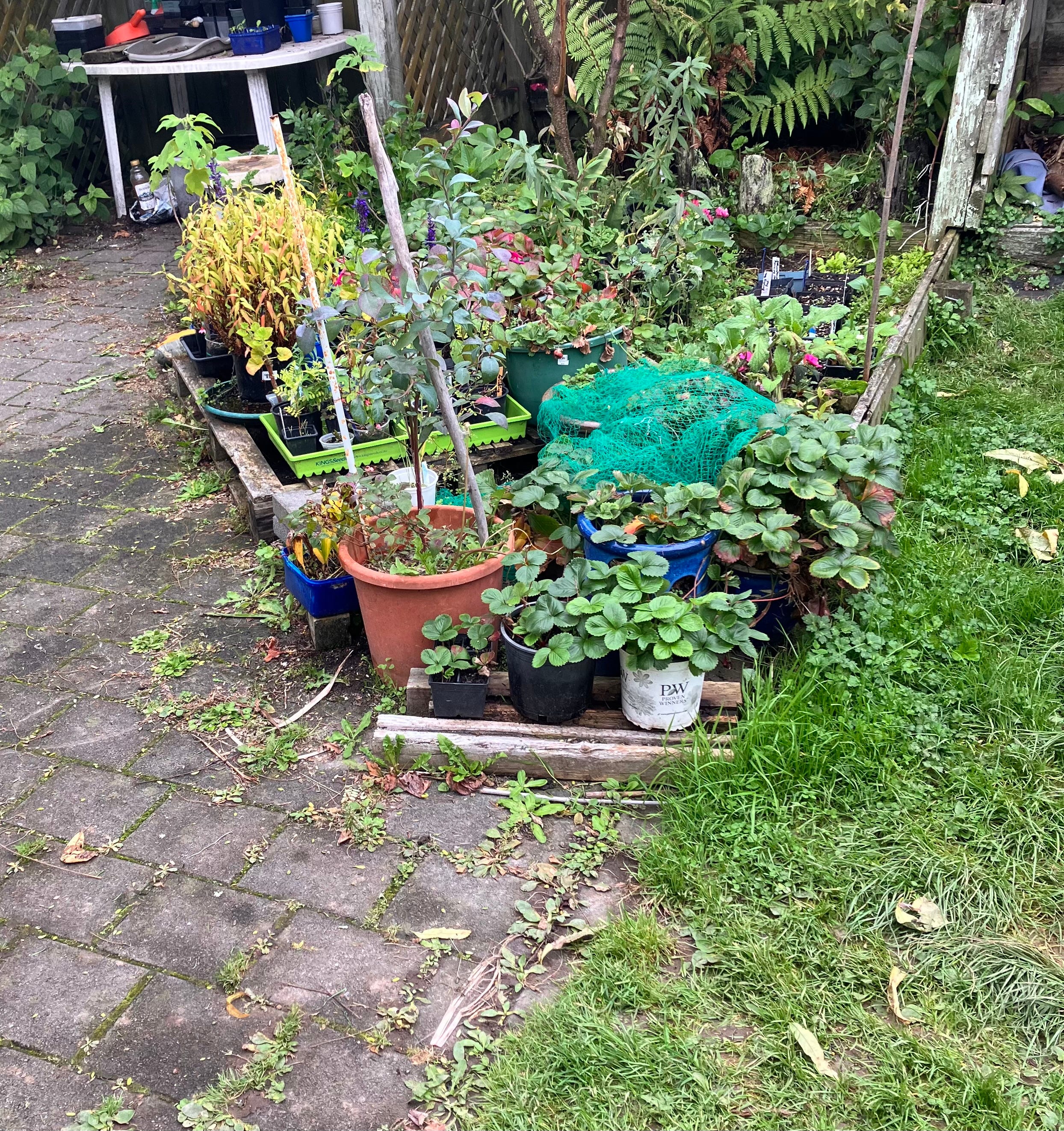
As well as that work, I’d actually be placing some of my vegetable garden in one of the least well drained parts of the section – not an especially good move. There are a few spots in the backyard that are raised and are good for vegetables, but these are much smaller than 5m by 3m (I’ll come back to at least one of these later).
I’m certainly not opposed to the idea of growing vegetables in the front part of the section which is deeper than the backyard and which also gets good sun. But the most obvious (and largest) area of lawn for such an endeavour is occupied by a rather precious golden elm tree which we like – the birds like it too. Elsewhere in the front garden, we’ve got quite a few garden beds, long established as well as new. But these are often busy hosting fruit trees (we’re trying to grow roughly in the food forest way) as well as flowering plants and native shrubs. There is some room for vegetables in the mix here, but on a much smaller scale than a 5m by 3m space.
Hence the logic of utilising several separate and smaller plots, some of which are out in the backyard, and some out the front, with some narrow strips down the sides of the house too. In sum, I have somewhere between a dozen and fifteen of these (it depends on what I include in the calculations). And together they comprise about 15 square metres of vegetable gardening.
A Selection of Areas
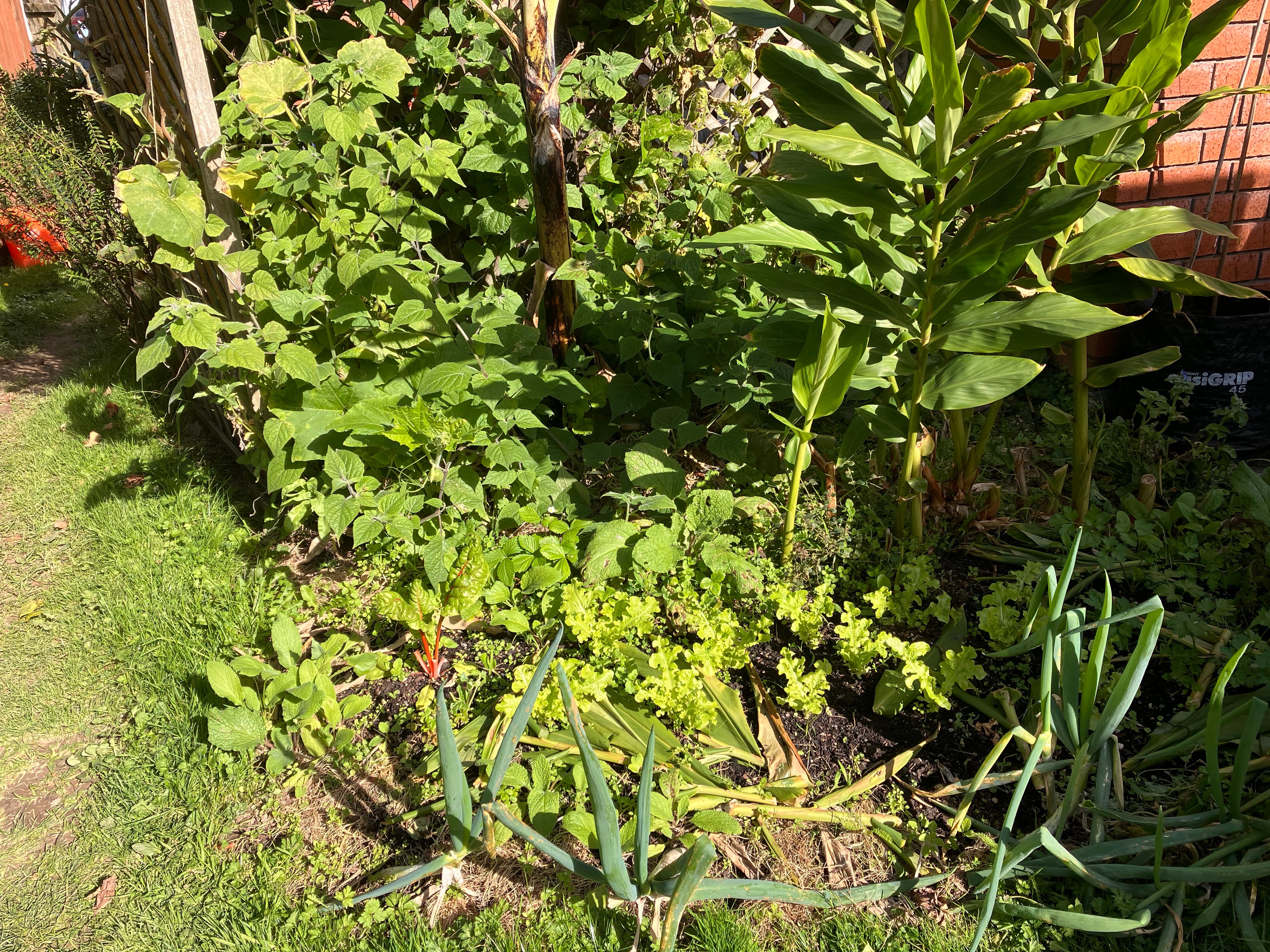
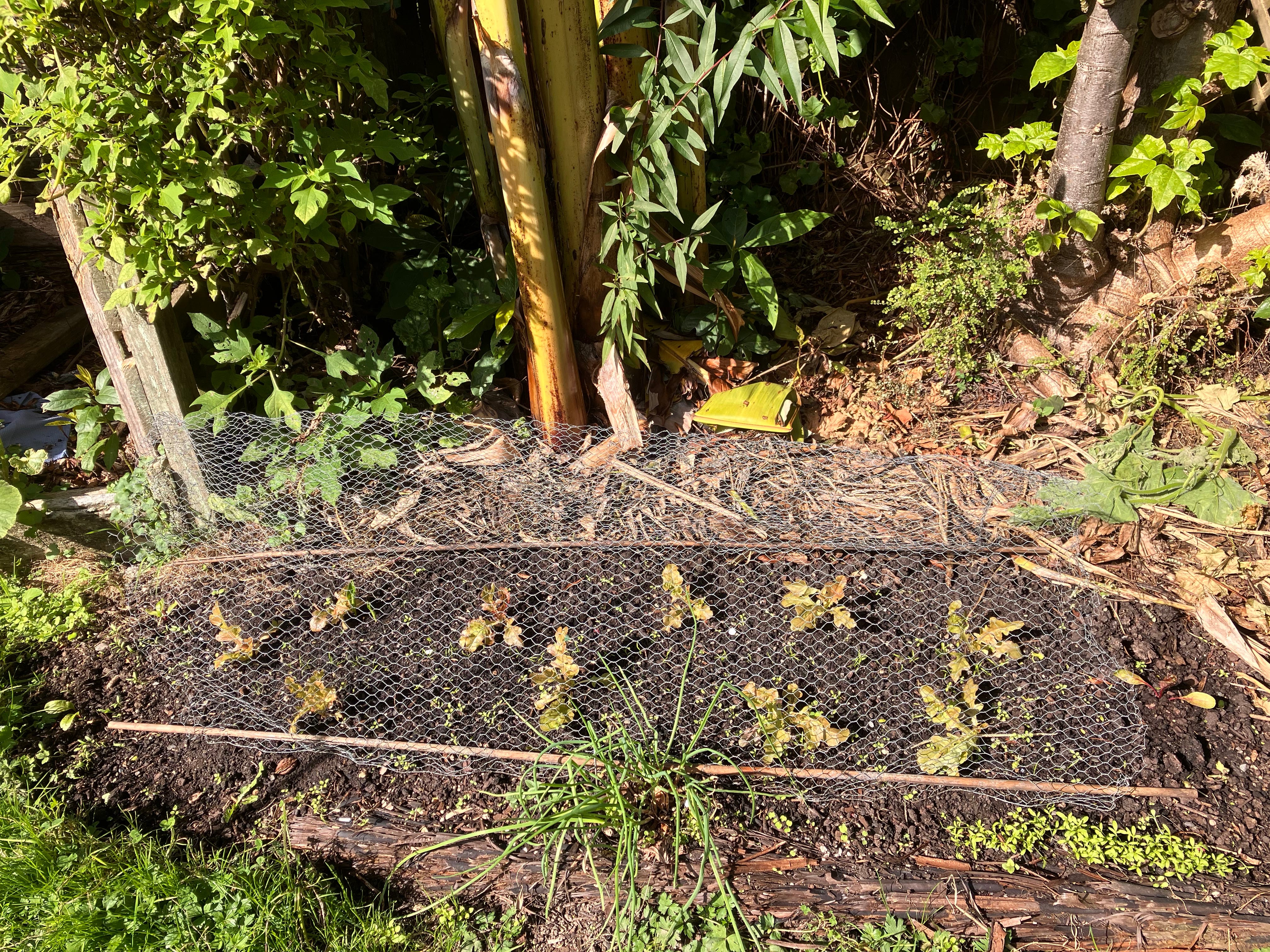
These mini-beds come in various shapes and sizes. In the backyard, for example, is an area that housed some perennial non-edible plants. In the front part of this particular space there now sits a wide row, of about 200cm by 70cm. I call this the Mona Lisa garden, named after the variety of banana (a hybrid bred in Honduras) it is positioned next to. And by building up the soil with some compost it has become a good place for both summer vegetables (including tomatoes and zucchini) and at other times veggies that prefer cooler months. Currently it is home to a dozen oakleaf lettuces, three parsleys, and a rainbow chard that was left over from some planting elsewhere:
Out in the front, perhaps the largest area for vegetable growing is a 300cm by 120cm space known as the lounge garden (for obvious reasons due to the room that looks out onto it). Facing west to northwest, it gets plenty of sun, but almost too much heat bakes down on this patch in mid-summer!
When we arrived this area was adorned by leggy shrubs that were trying to grow in parched soil. Many of these plants were removed early on. As I did so I realised how many river stones were sitting under our soil surface. And so that has encouraged me to garden up rather than down – to build up a layer of organic material into which to plant things.
With a fair bit of compost added, (maybe 7cm or more) I’m using a deep mulch variety of vegetable gardening in this area. And this is where one of the two low tunnels sits – these encourage growth between mid-autumn and mid spring by increasing the average temperature and decreasing the wind. Here is a recent image:
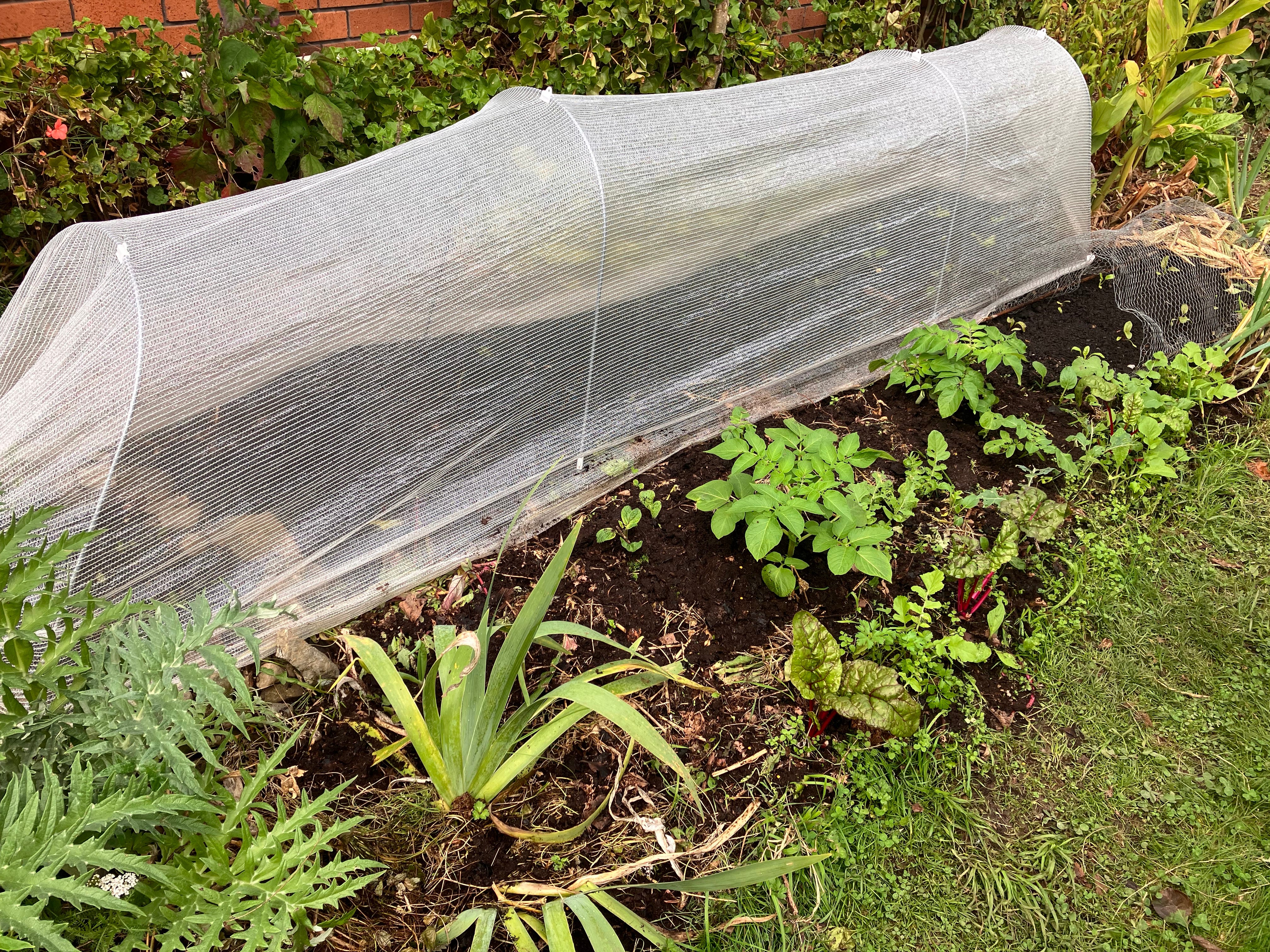
Right now there are lettuces, chard, a small number of potatoes (which do take up a fair bit of space), as well as mustard, collards, parsley, and a globe artichoke (the resident perennial vegetable) growing in the lounge garden. For some reason I’ve added an iris. And I’ll continue to encourage supporting flowers – like borage and calendula – when these appear in their self-seeded ways. I’ll also be sowing some more carrots – last year the deep compost system allowed me to get some (relative) success with this crop which has eluded me in the past.
Summer production has been more of a mixed affair in this area – it was probably best when I decided the warm season before last to grow lettuces in the summer by draping shade cloth over the low-tunnel. We did get a few tomatoes, zucchinis and beans during the warm season that has just ended, but they’ve tended to do better elsewhere in the section. Yet with persistence, as the soil improves over time, I think summer production will develop.
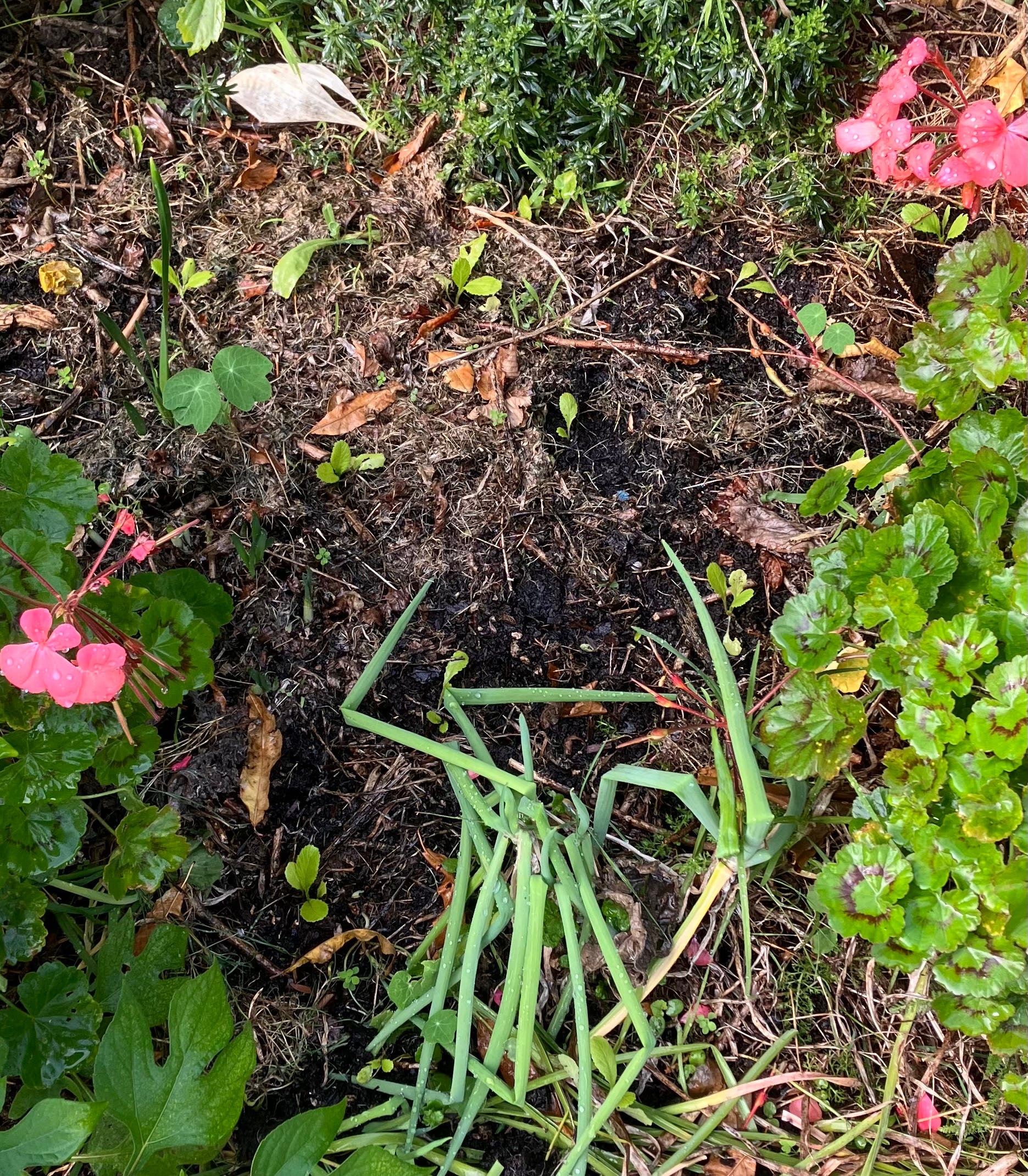
Not far away is perhaps one of the smallest plots – with a few mustard plants recently put into a less than 0.5 square metre space that held tomatoes in the summer and which also has some of my ubiquitous spring onions growing on the front edge – placed there partly because it is so easy to walk along and harvest them. This is what it looks like – you’d be excused for missing it as you walked past:
One of my plots is a recent vegetable growing experiment. A while ago in these pages I wrote about using the (formerly grassed) area under our gold elm tree to grow some cover crops. I also added in some flower seeds and coriander seeds I had spare in one part of that garden circle. Well, the cover crops didn’t really take off – I think the birds may have eaten some of them. But the flowers and coriander did quite well – with the latter making some especially nice contributions to salads. And that made me think that veggies might be a possibility for this area.
What we now have in over half of that space is a series of short rows that run as if they are spokes on a cartwheel from the outer rim of the circle towards the tree (whose immediate surrounds are still a covering of grass to help protect the lower trunk of the elm). I’ve put some extra compost down in these rows and have a range of edibles growing there – lettuce, chard, rocket, coriander, and carrots. Here is what it looked like just the other day:
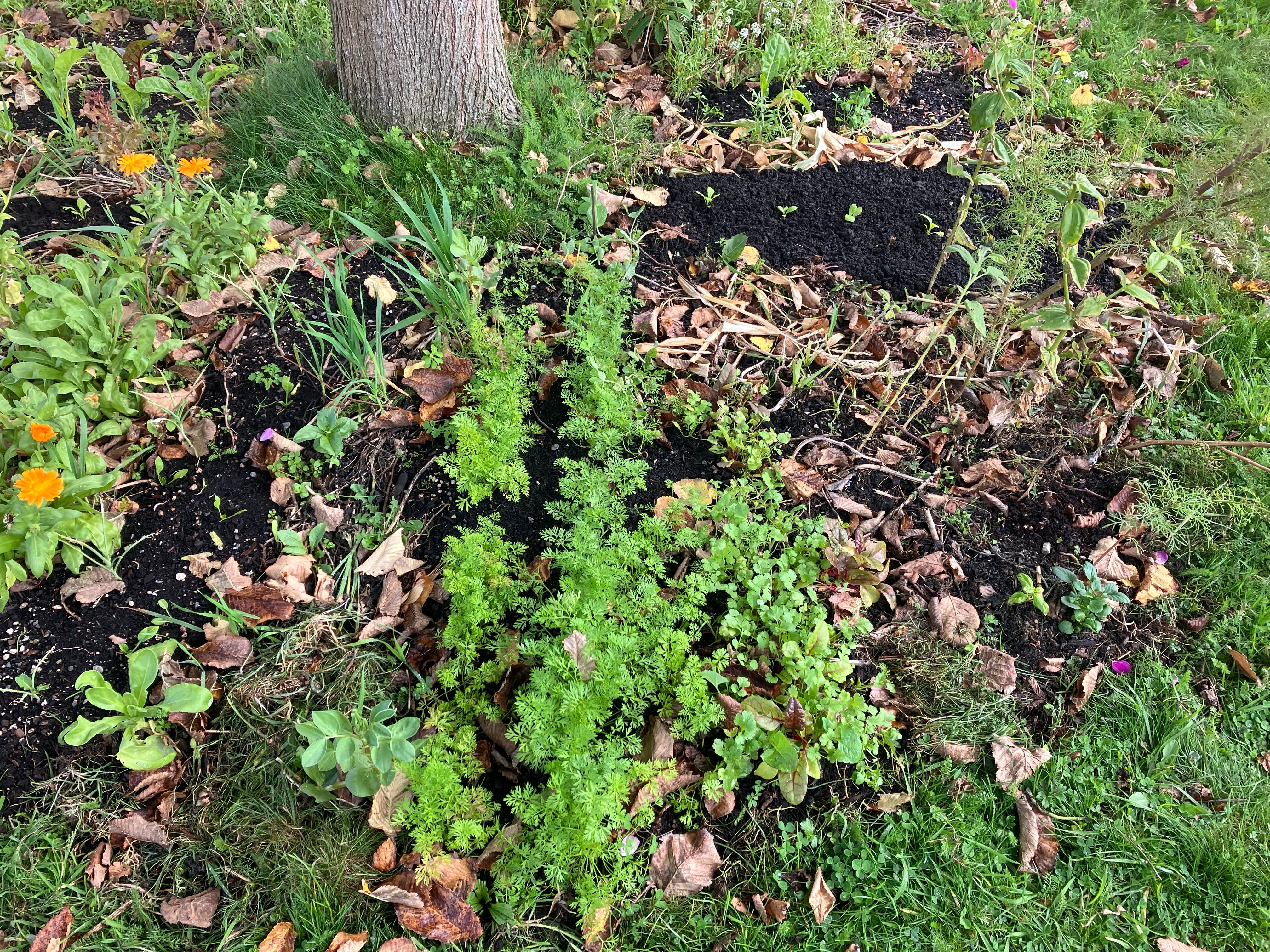
These plants are certainly not huge – I think the roots of the elm are gobbling up a fair bit of the available nutrients and drinking much of the moisture. But we are getting a few small leaves to harvest. And as the sun lowers in the late autumn sky, more light is hitting these plants. Even more will do so once the elm goes into its deciduous phase. So I am hoping this area (I have perhaps 2 square metres set aside for vegetables in this circular space) will become a productive spot for edibles in at least some parts of the year.
Cons and Pros
All gardening styles have negative as well as positive attributes. So let’s be up front and start with disadvantages to growing vegetables in several small beds. I think these come down to different aspects of the same issue: inefficiency.
The first extra bit of work you need to do (as opposed to growing veggies a single large bed) makes itself very well known when it gets warm and the plants and beds need some water. I water by hand (the explanation I tell myself is that it allows me to keep track of the plants). And with so many beds, it means a lot of time and walking with the hose and watering can from bed to bed.
If you want to add compost to your multiple beds you’ll also be lugging that round to many different spots, rather than dumping it on the edge of one bed and spreading it out. You’ll also need to mentally keep track of what you have in all these beds. One reason for the names of the small plots is that it helps me keep notes of what has been sown and planted where. And when you venture outside is not possible to look out on all your crops with one sweeping gaze – especially if you have vegetables front as well as back.
Another inefficiency might also arrive if you want to protect plants in these many beds. Unless they are also of the same dimensions (which isn’t my situation) the same piece of garden fabric or some chicken wire you’ve woven around bamboo stakes to protect young seedlings will work in some areas but not all. You can see one of these in my garden here (in another backyard plot that sits in front of a banana):
You’ll soon find there is a very good reason why so many market gardeners insist on having all beds the same length and width! And when harvest time comes for your vegetables (which can be a daily occurrence when it comes to salad plants and herbs) you have only one visit to make if they’re all sitting in one spot.
But I also think there are real advantages to scattering beds where you can grow them in different parts of the section. One is that it gives you a chance to take advantage of the different microclimates that pertain around your house. For example, areas that are shadier and damper than others can come into their own in summer where they offer salad greens a respite from the hot and dry conditions. Placed in these spots the plants, which prefer cooler weather, are less likely to struggle.
Down one side of the house is a narrow garden (about 200cm by 45cm) in front of a red flowering rhododendron. I have room there for one row of vegetables – currently mainly chard, but also a couple of lettuces and some celery too. Here is a recent image:
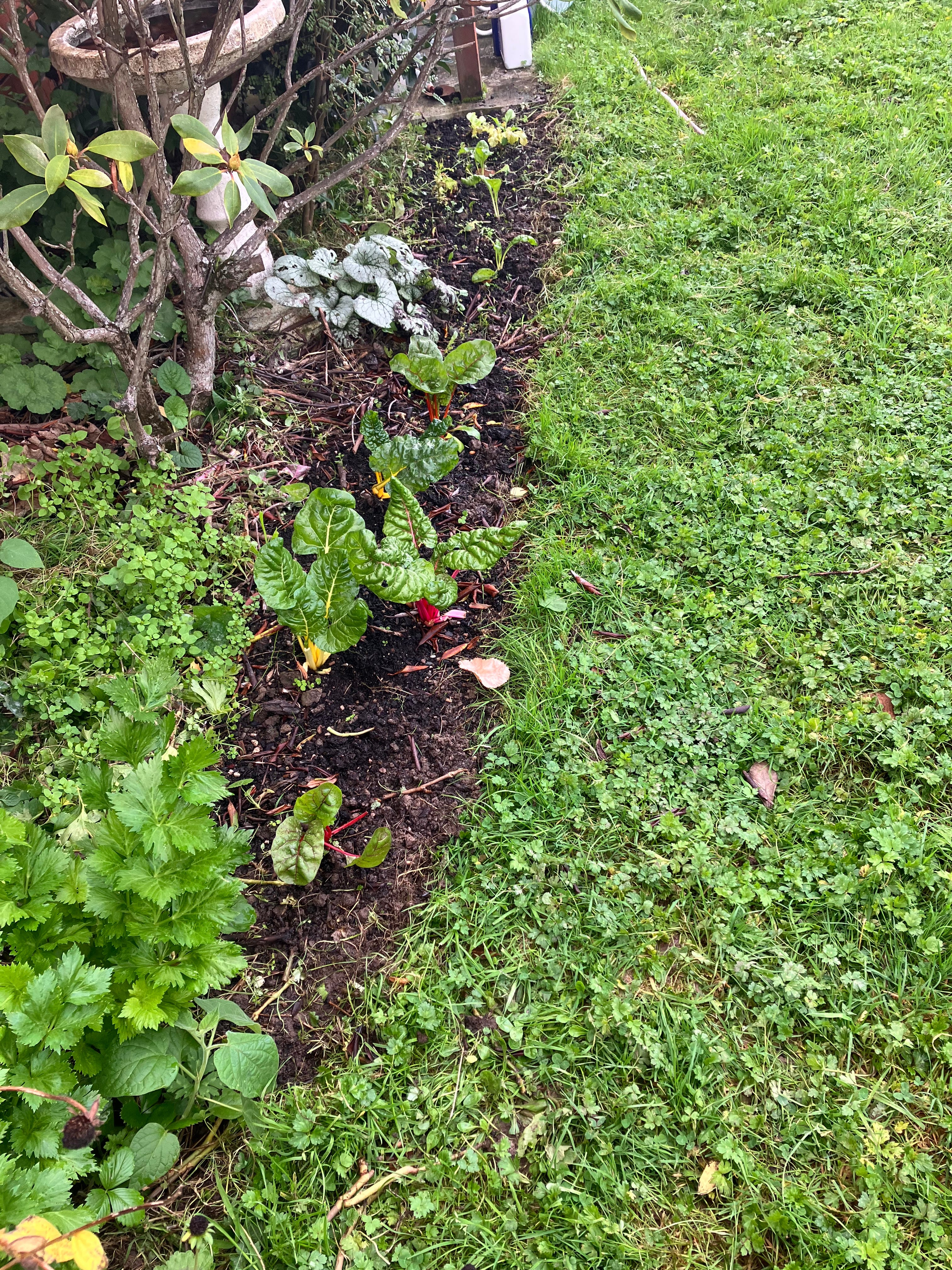
I may expand this garden further into the lawn. I’ll ask the grass (which as you may notice is full of buttercups) nicely of course, before putting a narrow strip of cardboard on top to begin that process. And I’ve already written about a corresponding damp and shady spot on the other side of the section – near a south facing fence.
Putting the same variety of vegetable plants in different beds in different parts of the garden also helps you learn more about the variety of conditions that pertain where you are living and gardening. Little details – like when the sun stops shining on this piece of ground and whether the soil supports heavy feeding plants or just ones that are not demanding of much nutrition can tell you a lot about the place (really the places) where you garden.
There is also a trade-off to be considered. While you definitely can get more efficiency in a single large plot I think you’ll get more gardening resilience from a series of scattered small plots. When all your vegetables are concentrated in a single large garden, they’re exposed together to a pest or disease that happens in one of your rows. But when a smaller, separate, bed comes under pressure, you may find that other separated areas are less likely to be affected. One mistake (applying some dud compost) made in a single large bed is a potential challenge for all your plants. When made in a smaller bed, you may have a better chance to keep the effects localised.
In a single large plot you’ll need to introduce flowering and fragrant plants if you want your veggies to benefit from a more balanced ecology that includes plants that attract beneficial predator insects and that confuses the insects that you’d like to stay away from your veggies. But smaller plots integrated in various parts of your garden will likely end up living and growing next to flowering and fragrant plants that are already part of your gardening palate.
At least that’s been my experience in fitting in small vegetable plots wherever the garden will accommodate them. And there is actually an efficiency upside here too – introducing beneficial and companion plants into a large single plot means less space for the veggies, but when those plants are already adjacent to your new small bed, you can concentrate on just the edibles.
I like to think that my multiplicity of mini-plots spreads my gardening risks but also my gardening joy. There is something exciting about seeing part of tomorrow’s lunch or dinner sitting in a nook and cranny as you walk round the next garden corner.
Yet it is not really the accumulated advantages that have seen me choose this course of vegetable growing. It is an approach that I’ve moved to out of necessity.
If like me you face a situation where a large backyard plot simply does not make sense where you live, you might find this hodge podge approach merits some attention. But as with all things gardening, see if you can get some good initial results on a couple of beds before you go quite as over the top with this style of vegetable growing as I have!
What a great read Robert. Gardening in an urban setting has many challenges but as you have described sometime this can lead to an inventive way of using your space. I also have "little gardens" dotted around my section so that I can use as much ground as possible for growing. I suppose they are micro-microclimates?
I enjoyed the read and you are right it does have it's merits when it comes to diversity and learning about the different conditions suitable for different plants!